As organizations across government and industry accelerate AI and digital modernization efforts, one lesson continues to surface:
Technology alone does not deliver transformation. Adoption does.
Advanced analytics, automation, and AI capabilities are increasingly mature. Yet many programs struggle to move from pilot to enterprise impact. In most cases, the barrier is not the algorithm, but it is the organizational change required to operationalize it on a scale.
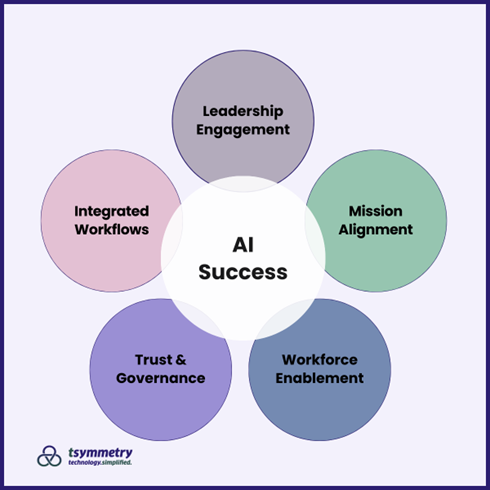
Successful AI programs are built on a strong human system, grounded in five core principles:
• Mission alignment AI initiatives gain traction when they are clearly tied to mission outcomes, operational efficiency, and workforce effectiveness, not technology for technology’s sake.
• Integration into existing operations Adoption increases when AI is embedded into established workflows, decision processes, and systems, minimizing disruption while enhancing performance.
• Trust, governance, and transparency Responsible AI practices including data stewardship, and clear accountability, are essential to building confidence among users and stakeholders.
• Workforce enablement Sustainable adoption requires continuous training, role‑based enablement, and investment in change networks that support long‑term capability development.
• Leadership engagement When leaders actively champion and model AI‑enabled decision‑making, adoption becomes part of organizational culture rather than a compliance exercise.
Organizations realizing value from AI are those preparing their people, processes, and governance structures to use those tools effectively.
AI does not deliver outcomes on its own. People supported by the right systems, leadership, and change discipline deliver outcomes.
As AI adoption accelerates across the enterprise, the critical question remains: Are we investing as intentionally in adoption and change management as we are in the technology itself?